

Please watch this compelling co-presentation with Summer Bell, Human Insights North America at The Coca-Cola Company, and Amishi Takalkar, Co-founder and CEO of Nailbiter. This is a case study on shopper research completed on the Coca-Cola mini can. This was recorded at Greenbook’s IIEX in Amsterdam, June 2026
CASE STUDY SUMMARY
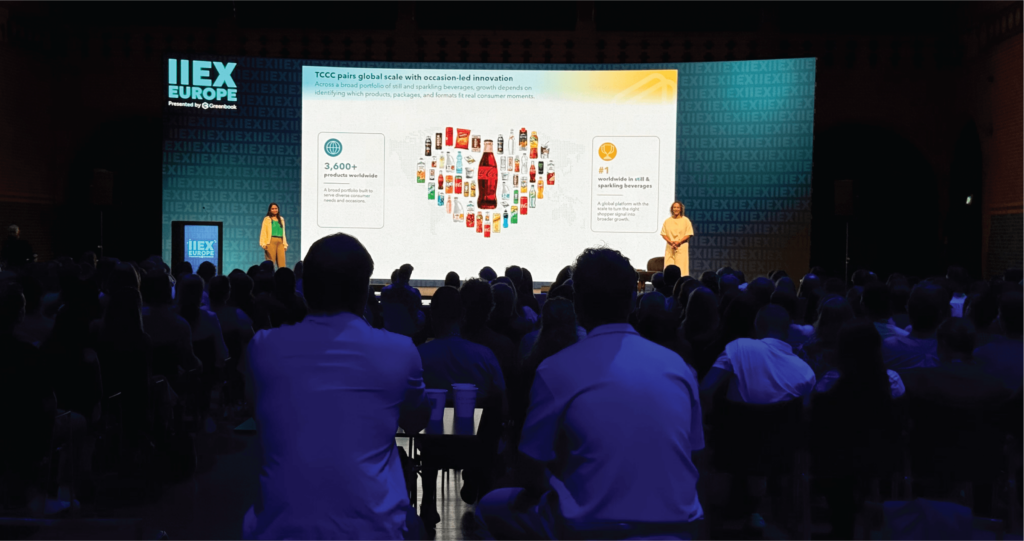
These brands have been part of all of our lives — the Coca-Cola brands, of course, but also many others across still and sparkling. Coca-Cola is an occasion-led marketing company, so from an insights perspective, it’s critical to hone in on the occasion that sparks interest for consumers and shoppers.
One way Nailbiter has helped unlock that is by examining the difference between what people say they do and what they actually do. That gap, often referred to as the “say/do gap,” is well known, but it’s especially compelling to see it come to life in research. A survey can only capture answers to questions built around an existing hypothesis. The real value comes when the research surfaces something nobody thought to ask about in the first place.
This case centers on an analysis conducted in the convenience retail sector for the Coca-Cola mini can. Much of what emerged was about unspoken needs: competitive pressure on shelf, pricing that wasn’t visible, and other small, nuanced realities of the retail environment that a paper survey simply can’t capture.
At a high level, the approach involved three things. First, capturing moments and behaviors as they actually happened in-store — how shoppers were engaging with the beverages, what they were doing, recorded on video with audio. Second, contextualizing that behavior by having shoppers narrate their thoughts as they shopped, so the research captured not just actions but in-the-moment reasoning. Third, comparing performance through clear KPIs and metrics — how the product performed in convenience versus how it did at Walmart at launch, from one period to the next, from one retailer to the next, from one season to the next — providing context that could be tracked over time.
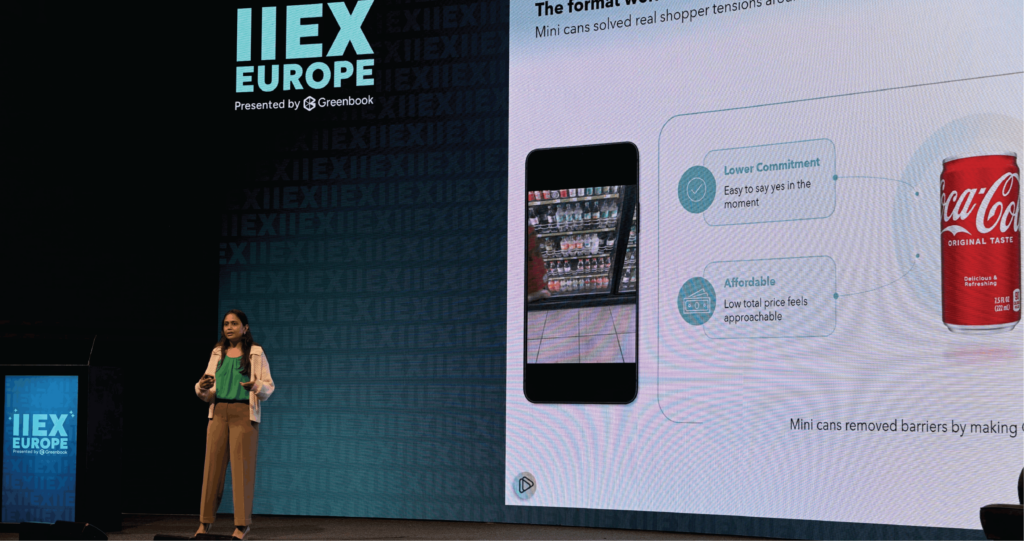
The mini can is a familiar, well-loved format, small, cute, easy to love from a brand perspective. But translating that into convenience retail posed a real question, since that channel skews toward male shoppers, for whom “small and cute” may not be the obvious draw. The mini can is typically sold in multi-packs in large grocery environments, so placing it in convenience stores represented a genuinely new occasion, and it wasn’t clear going in how it would land.
Coca-Cola traditionally pairs with food, meals, or snacks, so the open question was what to pair the mini can with in this new context. Rather than asking shoppers directly, it proved more valuable to have them walk the store with a camera, narrating their trip and decision-making in real time. That approach surfaced details shoppers didn’t realize they were revealing, and that wouldn’t have made it into a survey question to begin with.
The insight that came up repeatedly was that shoppers described the mini can itself as “my treat.” The assumption going in was that the mini can would be paired with an actual snack like chips, taquitos, or candy. Instead, shoppers treated the small size as the treat, or even the mini-meal, in its own right. That single insight reshaped how the brand could think about both above-the-line and in-store marketing.
The research surfaced several supporting patterns. Shoppers were more willing to commit to a smaller size, especially with formats like Coke Zero. There’s also a permissibility factor: the smaller size made a full-sugar original Coke feel like less of an indulgence. Price played a role too, with shoppers gravitating toward something closer to a dollar, lowering the barrier to purchase. And waste was a real concern with larger formats, as shoppers worried about a 20 oz going flat or warm before they finish it, whereas the mini can, in aluminum, gets consumed quickly and avoids that problem entirely.
In-store footage brought these patterns to life. One shopper explained she was picking up a mini can because she and her husband were heading out for a long weekend road trip, planning to pair it with chips and surprise him with the purchase. Another noted that while she’d normally reach for a liter or a 20 oz, those aren’t practical to carry around at work — the mini can was perfect for a work break. A third shopper mentioned pairing it with chips or cheddar cheese Bugles, but noted she wasn’t planning to buy it that day; instead, she saw it as something to grab another time for a quick afternoon pick-me-up.
Across these moments, a clear pattern emerged: shoppers in convenience stores were thinking about the mini can for snacking, grabbing it alongside something else during their trip. That made it possible to connect exactly what about the pack was resonating, on top of tracking raw performance — who was shopping for it, what the occasion was, what happened after purchase, where it was consumed, and how quickly.
That insight directly shaped the marketing plan. TV and video creative centered on a “Mini Can Big Deal” campaign, spotlighting the mini format itself, since it was capturing attention even though the brand was already available in other sizes. One important signal for future work: shoppers repeatedly asked for more flavor variety. The Core Four lineup of Sprite, Coke Original, Diet Coke, and Coke Zero had just launched, but with additional innovation planned for 2027, that shopper feedback was factored directly into planning.
Digital and social efforts focused on engaging younger consumers, while being careful not to cannibalize the 20 oz, which remains the brand’s workhorse format. A year of controlled sales testing showed the mini can performing well, but without the “why” behind it — who was buying, and for what reason. The Nailbiter research filled that gap, enabling sharper digital and social targeting, along with in-store creative such as pole toppers and pump toppers near gas pumps and store entrances, thereby building awareness that the format was now available in a new channel.
On the research side, one of the most rewarding outcomes was seeing those insights put into action and being asked to extend the pilot to additional retailers.
Once the mini can rolled out nationally, results showed category growth, incremental sales, and continued strong performance alongside the 20 oz format. Within Coca-Cola, this mattered internally too. With 60 franchise bottlers across the U.S. relying on the 20 oz as the top-performing package, there was real caution about introducing something that might compete with it. Having a clear, data-backed story, built largely for internal alignment before it ever reached customers, made the difference: the mini can wasn’t cannibalizing the 20 oz; it was growing the category incrementally. Since national launch, share and momentum have continued to build behind the new format.
The Importance of Shopper Context
Watching shopper behavior in context makes it possible to predict real-world outcomes in a way that simply asking people cannot. A strong hypothesis paired with direct questions can surface good ideas, but shoppers often reveal something meaningful without realizing it. Nonconsciously, they share details only the brand itself would recognize as significant. Bringing that footage back to leadership and to customers, showing real shoppers behaving naturally in real stores, proved highly effective.
Another unexpected benefit was footage revealing that pricing simply wasn’t visible on shelves in certain locations, a detail unrelated to the original research question but directly affecting purchase decisions. Some shoppers said they didn’t buy the product simply because that information wasn’t there. Beyond the primary findings, small environmental details like this proved just as important to surface, helping sharpen the overall story and strengthen the business case.
If your brand is ready for the power of behavioral data, you’re ready for Nailbiter. And we’d love to show you what videometrics can do for your brand. Nailbiter is a trusted solution for winning brands. Our global, quantitative videometrics platform captures hundreds of thousands of behavioral data points from real, in-the-moment shopping experiences to uncover actionable insights. Whether in-store, online, or in- or out-of-home, we create a space for consumers to “show and tell” at the moment of truth, delivering a more dynamic expression of what drives consumer behavior.
Follow-up Questions
Answer: Traditional research relies on people accurately recalling and reporting their own behavior, which is where the say/do gap comes in. People are often unreliable narrators of their own decisions, not because they’re being dishonest, but because much of shopping behavior is automatic, contextual, and shaped by factors shoppers don’t explicitly register, such as a missing price tag or a competitor’s shelf placement. Nailbiter closes that gap through videometrics, a methodology that captures real shopper behavior on video in the moment of purchase, whether that’s in a store aisle or during an online search. Shoppers narrate their thoughts as they shop, so the research captures both the behavior and the reasoning behind it, in real time, rather than relying on reconstructed memory after the fact. This produces a level of detail, capturing not just what happens, but the why behind it – a shelf, a package, a promotion or something else that may not register in a shopper’s memory after the fact.
Answer: Videometrics is Nailbiter’s approach to translating observed shopper behavior, both video and audio, into structured, quantifiable metrics like Notice, Cart, Conversion, and Shopability. Where a survey asks people what they did or intended to do, videometrics captures what shoppers actually did in the moment, then layers in the shopper’s own real-time narration to explain the why behind that behavior. The process follows four stages: shoppers are recorded in the Moment of Truth (Capture), their reasoning is layered in through narration or an add-on survey (Contextualize), human coders and AI convert that raw video and audio into actionable metrics (Convert), and the resulting insights are packaged into stories, dashboards, or playbooks teams can act on (Capitalize). Because the underlying data comes from real purchase behavior rather than self-report, it holds up across retailers, categories, and time periods in a way stated-preference data often doesn’t. With over a million shopper videos, and counting, Nailbiter is the world’s largest behavioral data platform.
Answer: Behavioral videometrics is designed to be predictive, not just descriptive. Because the underlying metrics, Notice, Cart, Conversion, and Shopability, are tied to observed purchase behavior rather than stated intent, they can be benchmarked against historical performance and used to understand how a product, pack, or in-store change is likely to perform before or after a wider rollout. In practice, this has meant identifying friction points in the shopper journey, like missing pricing or packaging confusion, that directly affect conversion, and using those findings to build an internal business case for a change before it goes to market. Because the same metrics can be tracked over time and across retailers, brands can also confirm afterward whether a launch delivered the incremental lift the behavioral data predicted.
Answer: One of the more delicate questions in any new pack, size, or channel launch is whether it will pull sales from an existing core product rather than add incremental volume. Because videometrics tracks actual purchase behavior across specific products, occasions, and retail contexts, it can isolate who is buying a new format, what occasion is driving that purchase, and whether it’s replacing or supplementing an existing choice. This distinction matters most internally, where stakeholders managing an established, high-performing product need reassurance before supporting a new entry that could appear to compete with it. Grounding that internal conversation in observed shopper behavior, rather than a sales forecast built on assumptions, gives teams a clearer, more defensible story for why a new format is expected to grow the category rather than divide it.
Answer: Self-reported data depends on shoppers accurately remembering and articulating decisions that often occur quickly, subconsciously, or under the influence of factors they don’t register, such as price visibility, shelf adjacency, or a subtle packaging cue. Video observation removes that dependency by capturing the decision as it happens and adding shopper narration to capture reasoning without requiring someone to reconstruct it later. This also reduces a burden that traditional surveys place heavily on respondents, and it sidesteps a growing data-quality problem in the research industry, where a significant share of online survey responses are now understood to come from bots or fraudulent panels rather than genuine shoppers. Real, observed behavior, validated by what people actually did on video, provides a foundation that’s both more accurate and harder to game than self-report alone.
Answer: Online shopper behavior has shifted significantly, and a large share of purchases now occur directly from search results pages, without shoppers ever visiting the full product detail page. That changes what actually influences a purchase decision, shifting weight onto search imagery, product titles, and visible pricing rather than the deeper brand story a product page is built to tell. Behavioral videometrics applied to online shopping captures exactly where and why shoppers add a product to cart or abandon it during that compressed decision window, identifying which specific attributes, images, or price cues are driving that outcome. Brands that have applied this kind of decision-point analysis to their e-commerce presence have used it to meaningfully improve cart and conversion rates without increasing ad spend, simply by better matching their online presentation to how shoppers are actually deciding in the moment.